
Astigmatism VS Myopia (Nearsightedness): What is the Difference?

Wondering about astigmatism vs. myopia? You’re not alone; these common vision problems often overlap and cause similar symptoms. Myopia (nearsightedness) causes blurry distance vision because the eyeball is too long, focusing light in front of the retina. Astigmatism causes blurry or distorted vision at all distances because the cornea or lens has an irregular shape, scattering light across multiple points. Both are refractive errors correctable with glasses, contact lenses, or surgery
Astigmatism vs Myopia – Key Differences
| Factor | Myopia (nearsightedness) | Astigmatism |
|---|---|---|
| Cause | The eyeball is too long, or the cornea is too curved. Light focuses in front of the retina. | The cornea or lens has an irregular shape. Light scatters across multiple focal points. |
| Vision affected | Distant objects are blurry; near vision is clear | Blurry or distorted at all distances, near and far |
| Common symptoms | Squinting, headaches, difficulty seeing signs or boards | Eyestrain, halos around lights, difficulty with night vision |
| Does it worsen? | Yes, often progresses through childhood and stabilizes in the mid-20s | Can fluctuate but rarely worsens significantly |
| Long-term risks | High myopia raises the risk of retinal detachment, glaucoma, and macular degeneration | Rarely causes serious eye-health complications |
| Prescription | Single negative sphere number, e.g., -3.00 | Cylinder + axis value, e.g. -2.00 x 90° |
What is Astigmatism?
Astigmatism is a unique refractive error because it can cause both near and distant vision problems. This condition occurs when the lens or cornea has an irregular or cylindrical shape.
Minor astigmatism is relatively common, as a perfectly round eye shape is uncommon. In many cases, individuals with minor astigmatism may never notice any symptoms. However, those with moderate to severe astigmatism will likely experience symptoms and require methods of vision support.
Common symptoms of astigmatism
- Headaches
- Eyestrain
- Eye Irritation
- Difficulty with Night Vision
- Squinting to Focus Vision
Also Read: What Does Astigmatism Look Like?
Treatment Options for Astigmatism
- Eyeglasses: The most common correction method uses toric lens eye glasses, designed with specific, targeted power in certain areas to correct the eye’s uneven shape.
- Contact Lenses: Specialized soft toric or rigid gas-permeable (RGP) lenses are often used, which stay in place on the eye better than standard lenses to provide clearer vision.
- LASIK Surgery: LASIK reshapes the cornea using a laser to permanently correct astigmatism and reduce dependence on glasses or contacts.
- PRK Surgery: PRK is another laser-based option, suitable for patients with thinner corneas. Recovery takes longer than LASIK but offers similar results.
- Orthokeratology (Ortho-K): Special rigid contact lenses worn overnight temporarily reshape the cornea, allowing clear vision during the day without lenses.
- Refractive Lens Exchange (RLE): Refractive Lens Exchange replaces the eye’s natural lens with an artificial one, often used for higher degrees of astigmatism or when combined with other vision issues.
What is Myopia?
Myopia, commonly known as nearsightedness, refers to the ability to see close objects clearly while distant objects appear blurry. This refractive error typically develops during childhood and often stabilizes between the ages of 20 and 40.
Common Symptoms of Myopia
- Blurry distance vision
- Squinting
- Eye strain
- Headaches while watching screens or driving
- Difficulty seeing road signs, classroom boards, or distant objects
Treatment Options for Myopia
- Eyeglasses: The easiest and most common solution. Concave lenses help refocus light onto the retina for clear distance vision.
- Contact Lenses: Soft or rigid gas-permeable contact lenses provide a wider field of vision and can be more convenient for active lifestyles.
- LASIK Surgery: LASIK reshapes the cornea to permanently correct myopia, reducing or eliminating the need for glasses or contacts.
- PRK Surgery: PRK is a laser procedure similar to LASIK, often recommended for patients with thinner corneas.
- Orthokeratology (Ortho-K): Special overnight lenses temporarily reshape the cornea, allowing clear vision during the day without corrective eyewear.
- Myopia Control Treatments (for children): Options like low-dose atropine eye drops and specialized contact lenses can slow the progression of myopia in children.
As myopia is frequently diagnosed in childhood, it is crucial to implement myopia control measures as early as ages 4 to 6 to prevent further complications in adulthood. Regular eye exams for children play an essential role in monitoring early eye health and managing myopia effectively.
What is the Difference between Astigmatism and Myopia?
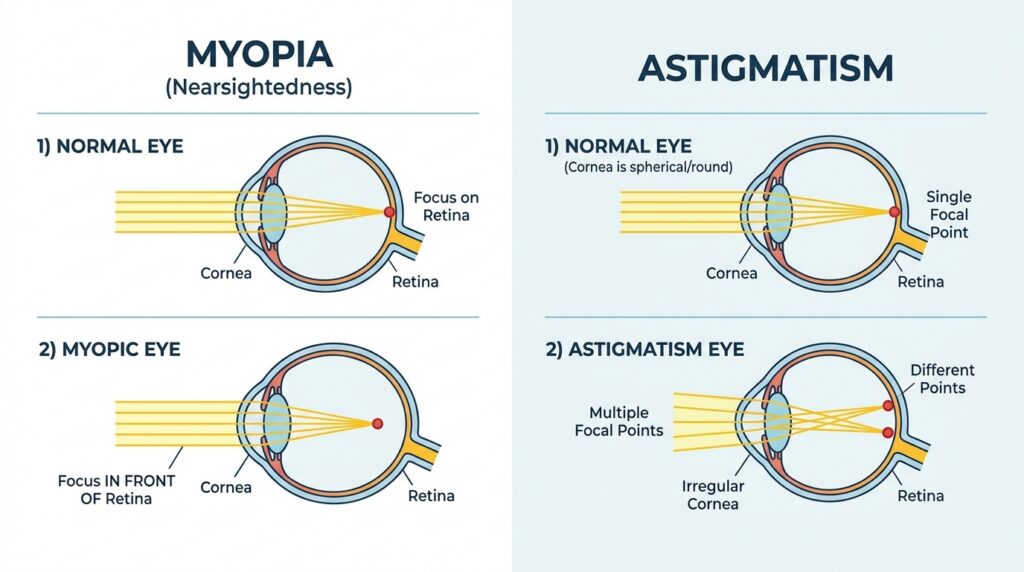
1. Shape
Astigmatism occurs when the cornea or lens has an irregular or cylindrical shape, causing light to scatter instead of focusing at one point.
Myopia develops when the eyeball is too long, or the cornea is more curved than normal, making light focus in front of the retina.
2. Vision Problems
Both conditions can blur distance vision, but astigmatism may also cause blurred near vision, along with distortion or shadowy images.
In severe forms of myopia, especially degenerative (pathologic) myopia. Additional complications, such as retinal thinning, tears, or macular problems, may occur, which can affect central vision.
3. Rarity
Astigmatism is actually the most common refractive error, but many people have only a mild amount and may not notice symptoms.
Myopia, especially progressive or degenerative myopia, is becoming increasingly common worldwide, appearing earlier in childhood and often worsening into adulthood.
4. Severity
Both conditions vary in severity, but high myopia poses greater long-term risks. It can increase the likelihood of serious eye problems like retinal detachment, glaucoma, or macular degeneration.
Astigmatism rarely leads to eye-health complications; it mainly affects clarity and comfort.
5. Lens Prescription
In a spectacle prescription, astigmatism is shown as a value inside brackets (the cylinder power) along with an axis (degree) that indicates the orientation of the irregular curvature.
Myopia, on the other hand, is written as a single negative number indicating the lens power needed to correct nearsightedness.
For instance, let’s consider the prescription: OD – 3.00 (-2) 90°, which pertains to the right eye.
In this case, it signifies:
- Myopia (nearsightedness) of 3 diopters.
- Astigmatism of 2 diopters at an axis of 90 degrees.
Final Thoughts
Understanding the differences between astigmatism and myopia is key to properly addressing vision issues. While both conditions may affect our ability to see clearly, they have distinct causes and symptoms that require different treatments. Astigmatism occurs when the cornea or lens is irregularly shaped, resulting in blurred or distorted vision at all distances. Myopia, on the other hand, causes distant objects to appear blurry while close-up vision remains clear. By visiting an eye care professional and undergoing a comprehensive eye exam, individuals can determine whether they have astigmatism or myopia and receive appropriate treatment options such as glasses, contact lenses, or refractive surgery.
Get a Comprehensive Eye Exam for Your Myopia or Astigmatism at InSight Vision Center
If you’re experiencing blurred distance vision, distorted images, or frequent eye strain, a detailed eye exam is the first step toward clearer, more comfortable vision. At InSight Vision Center, our eye care specialists in Fresno use advanced diagnostic tools to accurately identify whether your symptoms are caused by myopia, astigmatism, or a combination of both.
During your comprehensive exam, your doctor will evaluate your visual acuity, measure your refractive error, assess corneal curvature, and check overall eye health to ensure nothing is overlooked. Based on your results, you will receive a personalized treatment plan, whether that is glasses, toric or soft contact lenses, or vision correction options tailored to your needs.
Not sure if you have astigmatism or myopia? Schedule a comprehensive eye exam today and let our experts provide a clear diagnosis and the right treatment for your vision needs.
Schedule an Appointment
FAQs – Astigmatism vs. Myopia
Is astigmatism worse than myopia?
Both astigmatism and myopia are common eye conditions. Astigmatism, while being the most prevalent refractive error, often remains minor and symptom-free. On the other hand, myopia can progress into more complex forms, such as degenerative myopia, which presents additional challenges.Which is more common, astigmatism or myopia?
Astigmatism holds the title for the most common type of refractive error. However, it often occurs in minor forms that may not manifest noticeable symptoms. Myopia, on the other hand, can range from mild to severe, with degenerative myopia becoming more prevalent.Can astigmatism be cured?
While astigmatism cannot be completely cured, it can be effectively managed through the use of glasses and contact lenses, which correct the resulting blurry vision. For individuals seeking a more permanent solution, refractive surgery is an option.What causes nearsightedness?
Nearsightedness occurs when the eyeball elongates excessively from front to back, or when there are irregularities in the shape of the cornea or lens, both of which are integral parts of the eye's focusing mechanism.Can you have both, Astigmatism and Myopia?
Yes, and it is very common. The two conditions are not mutually exclusive. A prescription like –3.00 (–2.00 x 90°) means the patient has 3 diopters of myopia and 2 diopters of astigmatism in the same eye.Can myopia be cured?
It cannot be “cured,” but it can be effectively corrected or managed.Can LASIK correct both myopia and astigmatism?
Yes. LASIK is one of the most effective treatments for both conditions.Can myopia and astigmatism be prevented?
Astigmatism, being largely hereditary and structural, cannot be prevented. Myopia progression, however, can be slowed, particularly in children.Can astigmatism cause permanent vision loss?
Rarely. Astigmatism mainly causes blurry vision and eye strain, not permanent damage.How do I know if I have astigmatism or myopia?
If only your distance vision is blurry, it is likely myopia. If vision is blurry or distorted at all distances with ghosting or halos around lights, astigmatism may be the cause. A comprehensive eye exam is the only way to know for certain.Do astigmatism and myopia feel the same?
They can overlap. Both cause blurry vision and eye strain. The key difference is that astigmatism often creates a distorted, shadowed, or stretched quality to vision at any distance, not just far away.This article is general information and isn't a substitute for an eye exam.