
When Should You Have Cataract Surgery?

Quick Answer
There’s no fixed vision score that triggers surgery. The right time is when cataracts start interfering with daily life, like driving at night, reading, or recognizing faces. Common warning signs include cloudy or hazy vision, glare and halos around lights, frequent prescription changes, and trouble seeing in low light. If any of these are affecting how you function day to day, it’s time to get evaluated. Waiting longer only makes the cataract harder to remove.
Your vision doesn’t fail overnight. It fades a little at a time, so slowly you adjust without noticing. You turn up the lights. You stop driving after dark. You blame your glasses. Then one day you realize the world just looks dimmer than it used to.
That’s how cataracts work. And it’s exactly why so many people wait too long to do something about them.
If you’re asking when the right time for cataract surgery is, the answer isn’t a number on a chart. It’s about how your vision is affecting your life right now. Here’s what to watch for, how cataracts progress, and what happens if you wait.
What are Cataracts?
Cataracts occur when the natural lens of the eye becomes cloudy over time. This clouding prevents light from passing through clearly, leading to blurry or dim vision. They are most commonly age-related but can also develop due to injury, medical conditions, or prolonged exposure to UV rays.
Learn more about: Cataracts: Types, Causes, Prevention, and TreatmentDoes Insurance Cover LASIK?
8 Warning Signs It’s Time for a Cataract Surgery
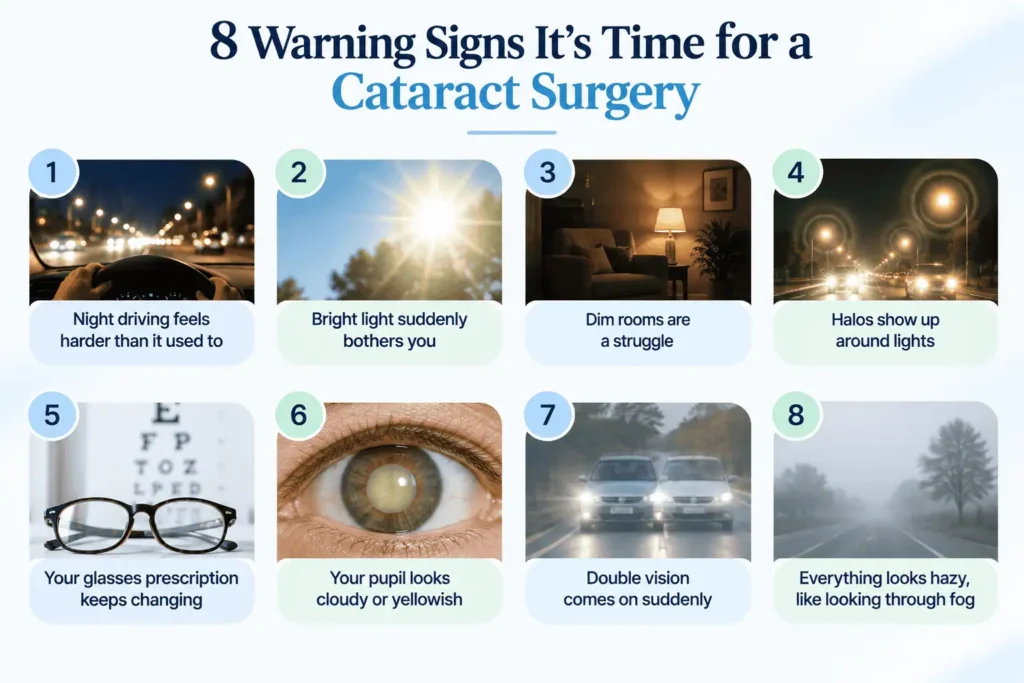
If you are wondering how to know when it’s time for cataract surgery, watch for these common signs.
-
Night driving feels harder than it used to
Headlights glare more than they should, and streets feel darker even on roads you know well. Depth and distance get harder to judge after sunset. Many people don’t notice the shift until they catch themselves avoiding night drives altogether.
-
Bright light suddenly bothers you
Sunlight or indoor lighting starts to feel harsher than normal, even in settings that never bothered you before. You squint more often or find yourself reaching for sunglasses indoors. This sensitivity tends to build gradually, so it’s easy to write off as tired eyes.
-
Dim rooms are a struggle
Reading in low light gets noticeably harder, and shaded or dimly lit spaces feel less clear than they used to. You need more lamps, more brightness, just to do what used to be easy. It’s often one of the first signs people adjust around without realizing why.
-
Halos show up around lights
Rings or glowing circles appear around headlights and streetlights at night, especially in the dark. This scattering effect happens as the cloudy lens bends light unevenly. It’s one of the clearest and most recognizable signs something’s changed.
-
Your glasses prescription keeps changing
New glasses, same blurry vision, is a pattern worth paying attention to. If updates aren’t fixing the problem, the issue may not be your lenses at all. Cataracts change the lens inside your eye itself, which glasses can’t always correct.
-
Your pupil looks cloudy or yellowish
In later stages, the pupil can take on a dull, milky, or yellow tint. This becomes visible to others, not just something you feel on the inside. It usually signals the cataract has progressed further than earlier symptoms suggested.
-
Double vision comes on suddenly
Seeing double in one eye, rather than both, is unsettling and different from typical blurriness. It happens when light scatters unpredictably inside the clouded lens. This symptom shouldn’t be ignored and is worth getting checked right away.
-
Everything looks hazy, like looking through fog
Colors dull, details blur, and even familiar faces or objects lose their sharpness. It stops feeling like normal aging and starts feeling like a real, daily problem. This is often the sign that finally pushes people to get evaluated.
Read more on – What is Blurred Vision? Symptoms, Causes & Treatment Options
How Cataracts Progress Over Time?
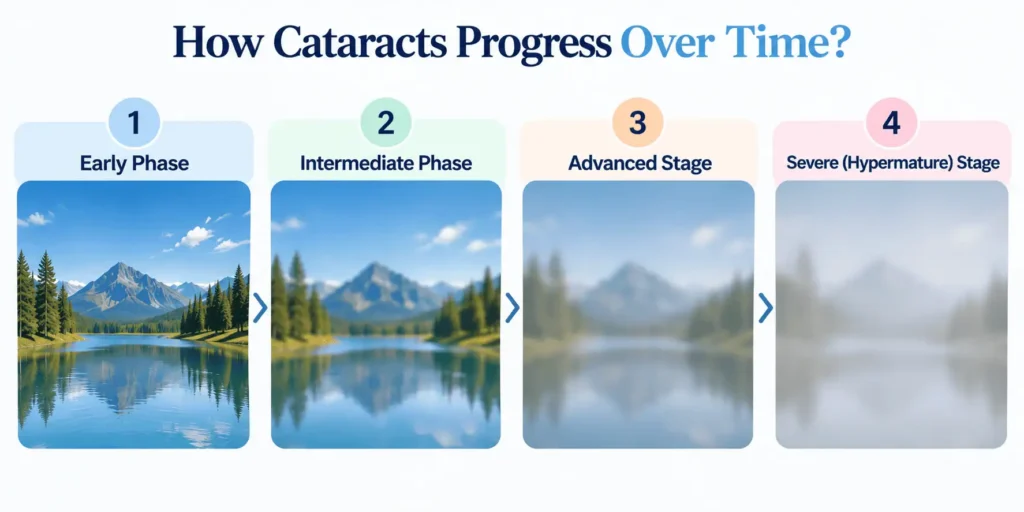 Cataracts develop gradually, moving through different stages. Knowing these stages can help you understand when you should have cataract surgery. Check them out here:
-
Early Phase
Vision changes are mild and easy to overlook at first. Glasses or better lighting can still help you manage day to day. Most people don’t think about surgery yet at this stage.
-
Intermediate Phase
Blurring becomes harder to ignore, and daily tasks start to feel more effortful. Reading, driving, and recognizing faces at a distance may all grow more difficult. This is usually when people first start asking about treatment options.
-
Advanced Stage
Vision is significantly impaired, and everyday activities become genuinely hard to manage. Watching TV, driving, and even recognizing people up close can feel frustrating or unsafe. At this point, most people are ready for surgery.
-
Severe (Hypermature) Stage
The lens becomes completely clouded, leaving very little usable vision. Surgery is still possible, but it becomes more complex and carries higher risk. Waiting this long is why doctors recommend acting well before this stage.
What Can Happen if You Delay Cataract Surgery?
Putting off surgery can feel harmless in the short term, but delay comes with real costs. Here’s what tends to happen when cataracts are left untreated.
-
Your vision keeps declining, not staying the same
Cataracts don’t pause or plateau on their own. Reading, driving, and even walking safely get harder over time, not easier. What feels manageable today can turn into a serious limitation within a year or two.
-
Falls and accidents become more likely
Poor depth perception and blurred vision make it easier to misjudge stairs, curbs, and distances. This risk is especially serious for older adults, where a single fall can lead to lasting injury. Protecting your vision early is also protecting your safety.
-
Surgery gets harder the longer you wait
A mature or advanced cataract is denser and more difficult to remove than an early one. That can mean a longer procedure, a longer recovery, and a higher chance of complications. Acting sooner keeps surgery simpler and safer.
-
Eye pressure can rise
In advanced cases, a swollen cataract can push eye pressure higher than normal. Left unaddressed, this can contribute to glaucoma, a separate and more serious condition. It’s one more reason not to let a cataract sit untreated for too long.
-
Daily life gets harder to manage
Cooking, recognizing faces, reading a phone screen, these small tasks add up fast when vision keeps slipping. Many people don’t realize how much they’ve quietly given up until vision is restored. Delaying surgery often costs more independence than people expect.
Learn more about: How to Prevent Cataracts from Getting Worse? 7 Best Tips
Timely Cataract Eye Surgery Guidance at InSight Vision Center, Fresno, CA
Knowing the signs is only half the equation. The other half is acting on them before cataracts start controlling your daily life.
At InSight Vision Center in Fresno, our team evaluates your vision using advanced diagnostic technology to pinpoint exactly how far your cataracts have progressed. From there, you get a treatment plan built around your eyes, your lifestyle, and your timeline, not a one-size-fits-all approach.
If you’ve noticed any of the warning signs above, waiting rarely makes things easier. The sooner cataracts are evaluated, the more options you have, and the simpler treatment tends to be.
Don’t let cataracts cloud your world any longer.
Get Cataract Eye Surgery at InSight Vision Center, Fresno, CA
Click Here to Book Your Consultation Today
FAQs About Cataract Surgery
At what vision level do doctors recommend cataract surgery?
There is no fixed number. Surgery is usually recommended when vision problems start affecting your daily life.What happens if cataracts are not treated?
They can gradually worsen and lead to severe vision loss. In some cases, complications such as increased eye pressure may occur.Do cataracts need to fully develop before surgery?
No. Modern techniques allow surgery to be performed safely before cataracts reach an advanced stage.Will I need glasses after cataract surgery?
It depends on the lens used. Some lenses reduce the need for glasses, while others may still require them for certain tasks.Can cataracts come back after surgery?
No, they do not return. However, a condition called posterior capsule opacification can occur and is easily treated.Can cataracts lead to blindness?
Yes, if left untreated, they can severely impair vision and may lead to functional blindness.Are both eyes treated at the same time?
Usually not. One eye is treated first, followed by the second after a few weeks.This article is general information and isn't a substitute for an eye exam.