
Refractive Lens Exchange: Ideal Candidate, Benefits, and Procedure
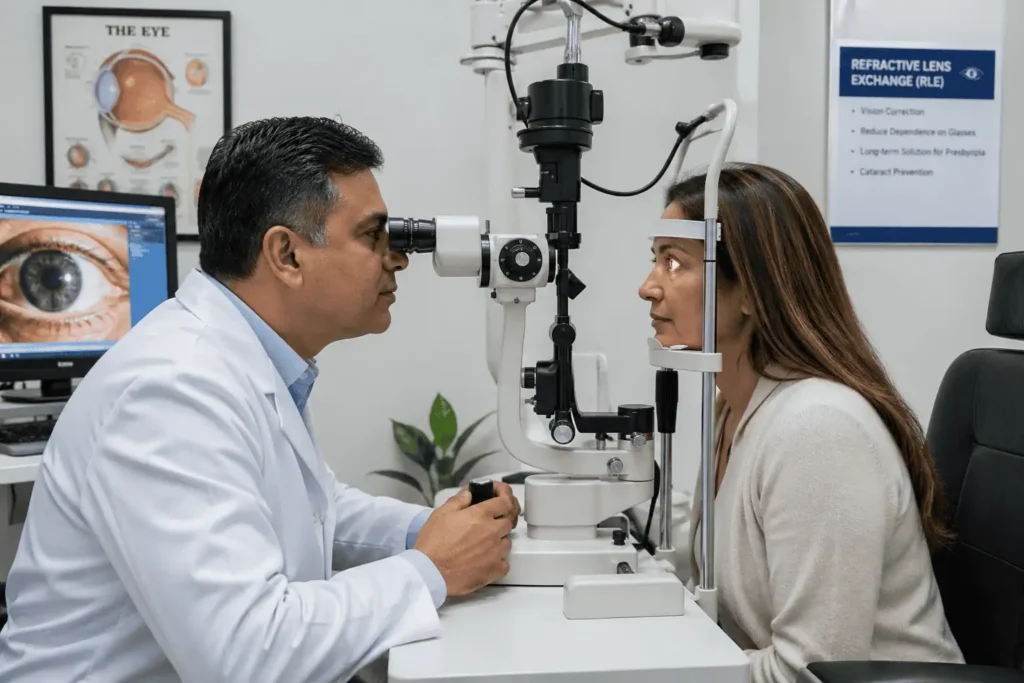
Key Takeaways
- Refractive Lens Exchange (RLE) is a long-term solution for people who are not eligible for LASIK.
- It replaces your natural lens with an artificial one to correct vision problems like presbyopia, nearsightedness, and farsightedness.
- Recovery is typically quick, with noticeable improvement within days.
- It also prevents future cataracts since the natural lens is entirely replaced.
While LASIK surgery has always been the most popular solution for treating vision problems, some individuals are not cut out for it. If you’ve been told the same, then worry not, you still have the option of undergoing another advanced procedure called Refractive Lens Exchange (RLE).
This guide will help you understand how refractive lens exchange surgery works, who it is best suited for, and what you can expect before, during, and after the procedure.
What Is Refractive Lens Exchange (RLE)?
Refractive Lens Exchange (RLE) is a vision correction procedure in which your eye’s natural lens is removed and replaced with an artificial intraocular lens. This new lens helps correct refractive errors such as farsightedness, nearsightedness, and presbyopia. It is very similar to cataract surgery, except it is performed before cataracts develop.
What makes RLE truly unique is that it is the only vision correction procedure capable of fixing both distance and near vision for people over the age of 45. Unlike LASIK, which only corrects distance vision and cannot address the age-related loss of near vision (presbyopia), RLE tackles both, making glasses or contact lenses for any distance a thing of the past.
The goal of this surgery is to reduce or eliminate your dependence on contact lenses or glasses while providing long-term visual clarity.
To read more in detail on RLE, see our Refractive Lens Exchange page for Fresno, CA.Who Is the Best Candidate for RLE?
Not everyone is an ideal candidate for RLE eye surgery, but certain individuals may benefit more than others. Here are some common characteristics of the best candidates:
- Age 40 or Above: Individuals experiencing presbyopia and needing reading glasses often benefit the most.
- Stable Vision Prescription: Your vision should remain unchanged for at least one to two years.
- Not Suitable for LASIK: People with thin corneas or high prescriptions may find refractive lens exchange surgery a better option than LASIK.
- Early-Stage Cataracts: It can address vision issues before cataracts progress.
- Overall Healthy Eyes: No advanced eye conditions like glaucoma or retinal disease.
- Seeking Long-Term Solution: Ideal for those seeking a permanent correction method.
What Are the Benefits of RLE?
If you are a suitable candidate for this procedure, here are the advantages you can experience:
- Long-Lasting Vision Correction: Is refractive lens exchange permanent? Yes, unlike some laser procedures, it offers a stable, long-term solution since the artificial lens does not change over time.
- Prevents Cataracts: Since the natural lens is removed and replaced with an artificial one, you won’t develop cataracts in that lens later on in life.
- Effective for Presbyopia: It helps restore near vision, which LASIK cannot fully address.
- Clear Vision at All Distances: Advanced lenses can improve near, intermediate, and distance vision.
- Alternative to LASIK: A great option for patients who are not candidates for laser procedures.
- Quick Recovery: Most patients notice improvement within a few days.
How Is the Refractive Lens Exchange Surgery Performed?
-
Before the Procedure
You will get a mild sedative, and numbing eye drops will be applied so you do not feel discomfort. The procedure typically takes about 15 to 30 minutes per eye.
-
During the Procedure
The procedure starts with the surgeon making a small incision in the cornea. A specialized tool gently breaks up and removes your natural lens. A new artificial lens is placed inside your eye to restore clear vision. The incision heals naturally without stitches.
-
After the Procedure
This is an outpatient procedure, so you can go home the same day. Your doctor will guide you on whether both eyes should be treated at once or separately based on your needs.
Refractive Lens Exchange vs LASIK: What’s the Difference?
While both procedures are used to correct vision, the main difference lies in how the vision is corrected.
- LASIK reshapes the cornea using a laser.
- Refractive lens exchange surgery entirely replaces the natural lens.
| Aspect | LASIK Eye Surgery | Refractive Lens Exchange (RLE) |
|---|---|---|
| Treatment Approach | Uses a laser to reshape the cornea and improve how light enters the eye. | Replaces your eye’s natural lens with an artificial intraocular lens. |
| Best Suited For | Individuals under 40 with mild to moderate vision issues and healthy corneas. | Adults typically over 40 with presbyopia, high prescriptions, or thin corneas. |
| Near Vision (Presbyopia) | Does not effectively treat age-related near vision loss. | Can correct presbyopia with advanced lens options. |
| Long-Term Outcome | Provides lasting results, but natural aging of the eye may still affect vision over time. | Offers a permanent solution and eliminates the future risk of cataracts. |
Read more about: LASIK Eye Surgery at InSight Vision Center
What Is the Cost of Refractive Lens Exchange?
RLE costs typically range between $3,000 and $8,000 per eye, depending on the type of lens used, the surgeon’s expertise, and the location of the clinic. A consultation with our team can give you a personalized estimate for your treatment.
What’s the Recovery Timeline of RLE Surgery?
- Days 1-3: Vision begins to improve, although mild dryness, glare, or sensitivity may occur.
- Week 1: Most patients return to work and resume normal activities.
- Weeks 2-4: Vision continues to stabilize as healing progresses.
- Months 1-3: Final healing is achieved, and vision becomes fully stable.
Post-Surgery Care: What to Do & What Not to Do After RLE Eye Surgery?
There are a few things to take care of once you’re done with your surgery:
What to do:
- Use prescribed eye drops regularly.
- Wear protective eye shields while sleeping.
- Use sunglasses to protect your eyes outdoors.
- Attend all follow-up appointments.
- Allow your eyes to rest during the initial recovery period.
What to avoid:
- Do not rub your eyes.
- Avoid heavy lifting and strenuous activity.
- Stay away from swimming pools and hot tubs for at least 2-4 weeks to avoid infection risks.
- Avoid driving until your doctor approves.
- Do not apply makeup near the eyes for at least a week.
- When showering, avoid direct water pressure on your eyes.
Post-Surgery Red Flags: When to Seek Immediate Medical Attention
Although RLE eye surgery is generally safe, it is important to recognize warning signs. Seek medical care immediately if you notice:
- A sudden increase in floaters
- Flashes of light in your vision
- A shadow or curtain-like effect in your field of view
Get Expert Guidance for RLE Surgery in Fresno, CA
If you’ve been told you’re not a candidate for LASIK — because of thin corneas, a high prescription, or presbyopia — that doesn’t mean you’re out of options. At InSight Vision Center’s refractive lens exchange specialists, our board-certified ophthalmologists have helped Central Valley patients trade reading glasses and blurry near vision for clear sight at every distance, without the limits LASIK runs into as your eyes age. Learn more about refractive lens exchange in Fresno, CA.
From your first consultation, our team walks you through your IOL options, answers your questions honestly, and builds an RLE treatment plan around your eyes, your prescription, and your lifestyle – whether you’re tired of readers, catching early lens changes before they become cataracts, or just ready to stop depending on corrective lenses for good.
Not sure if Refractive Lens Exchange is right for you?
Consult with the eye specialists at InSight Vision Center in Fresno, CA
Frequently Asked Questions
Does refractive lens exchange correct astigmatism?
Yes, specialized lenses can be used in the surgery to correct astigmatism along with other refractive errors.How long does refractive lens exchange last?
The results of refractive lens exchange surgery are long-lasting, as the artificial lens does not change over time.Can you have refractive lens exchange after LASIK?
Yes, patients who previously had LASIK can still undergo refractive lens exchange surgery if they are suitable candidates.Does refractive lens exchange hurt?
No, the procedure is typically painless as your doctor will use numbing drops and sedation.Is bladeless LASIK different from refractive lens exchange?
Yes, LASIK reshapes the cornea, while RLE entirely replaces the natural lens.When can you exercise after refractive lens exchange?
Light activities can resume within a few days, but strenuous exercise should be avoided for at least 1-2 weeks.This article is general information and isn't a substitute for an eye exam.